
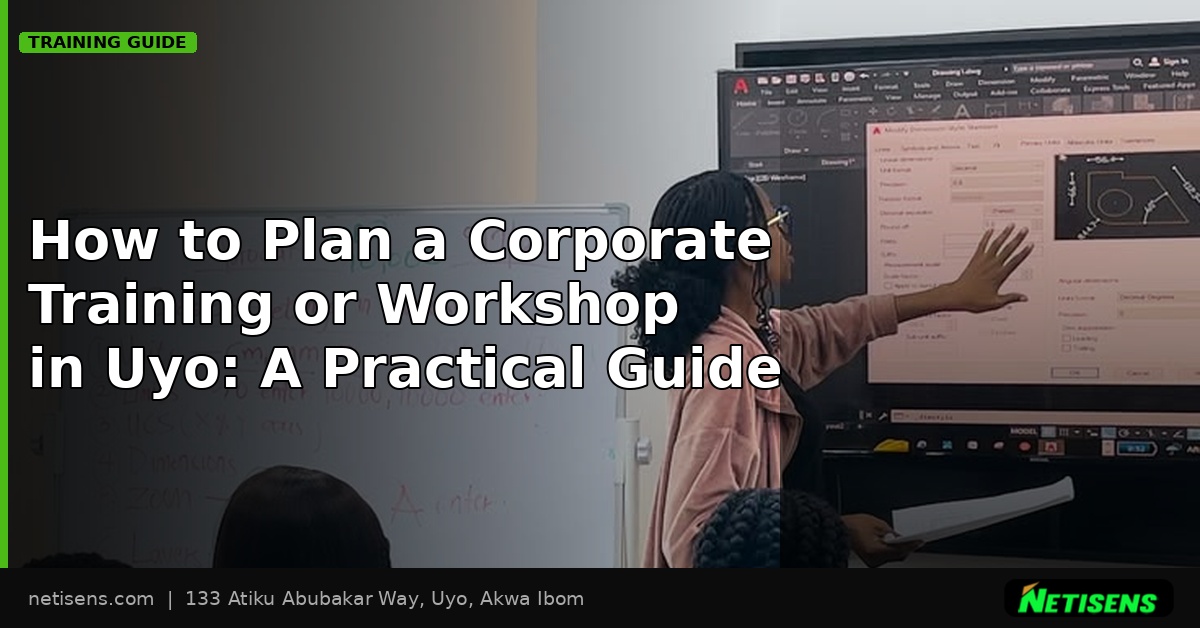
A well-planned corporate training session can transform a team. A poorly planned one wastes time, damages credibility, and costs more than it was worth.
Whether you are an HR manager, a business owner, or a consultant organizing a training for clients in Uyo, this guide walks you through every step. According to research from Harvard Business Review, training programs that have a clear objective, structured delivery, and an appropriate environment produce measurably better outcomes than those that do not.
Step 1: Define the Goal of Your Training
Before you think about venue or budget, answer this clearly: what should participants be able to do differently after this training?
Vague goals produce vague results. “Improve team performance” is not a training goal. Teach the sales team to use CRM software confidently by the end of the session”. A specific goal tells you how long the training needs to be, what resources are required, who should attend, and how you will measure success.
Step 2: Know Your Audience
The format and content should match the people in the room. Key questions to answer:
- What is their current knowledge level on this topic?
- How long can they focus before needing a break?
- Do they learn better from presentations, hands-on practice, or discussion?
- Are they executives needing strategy or staff needing step-by-step practical skills?
If your training involves tech skills like data analysis, digital marketing, or AI automation, Netisens ICT can also provide expert trainers for corporate team upskilling sessions. Contact the team to discuss.
Step 3: Choose the Right Venue
Your venue is not just a room. It is part of the experience. For corporate training and workshops in Uyo, the Netisens ICT conference hall at 133 Atiku Abubakar Way provides capacity for 10 to 100 participants, air conditioning, a projector and screen, high-speed internet for live demonstrations, and flexible seating configurations.
Pricing starts at N20,000 for a half day (10 to 35 people) and goes up to N100,000 for a full day with up to 100 participants.
Step 4: Plan Your Content Structure
A practical structure for a full-day workshop:
- 8:00am to 8:30am: Registration and networking
- 8:30am to 10:30am: Session 1 — core content delivery
- 10:30am to 10:45am: Break
- 10:45am to 12:30pm: Session 2—practical exercises or group work
- 12:30pm to 1:30pm: Lunch
- 1:30pm to 3:30pm: Session 3 — application and case studies
- 3:30pm to 3:45pm: Break
- 3:45pm to 5:30pm: Session 4 — Q&A, action planning, and wrap-up
For additional guidance on structuring effective learning experiences, MindTools has a practical workshop planning framework that works well for most corporate contexts.
Step 5: Sort Your Materials and Equipment
- Slides prepared and tested on the venue projector
- Printed handouts or digital resources ready to distribute
- Exercise worksheets and group activity materials printed in advance
- Name tags, attendance sheets, and evaluation forms
- Extension cables, adapters, and backup copies of all digital files
Arrive at least 30 minutes early to set up and test all equipment. Never assume the venue has tested your specific setup.
Step 6: Communicate Clearly Before the Day
Send participants all information at least 5 to 7 days before:
- Date, time, and venue address with a map link
- What to bring and any pre-reading required
- The full training agenda
- Parking and transport information
Booking Your Training Venue in Uyo
To book the Netisens ICT conference hall for your training or workshop, contact the team as early as possible. Also explore the private meeting room option for smaller group sessions and the coworking workspace for teams that need a productive working environment before or after the session.
Book via WhatsApp. · Call: 09116875415 · Visit netisens.com
